05 · Explore

Can people who are blind develop it too?

What if closing your eyes weren't a loss, but the discovery of another way to perceive?

Yes, and there's a published study that documents it

The short answer is yes. Intuitive Vision doesn't depend on the eye or the optic nerve, but on where we place our attention, so a lack of eyesight is no obstacle to developing it.

That doesn't mean getting your sight back. It means perceiving through another channel.

Since 2020 we have been accompanying people with total or severe blindness in a free program, and in September 2025 we published the study that gathers those results: “Assessment of intuitive or extraocular vision and intuitive perception in participants with total or severe blindness” (PDF in Spanish, open access).

Participants who can't see —some of them since birth— have identified colors, told shapes apart, sensed the outline of a room and, in some cases, read large words. And what they say changes in their everyday lives tends to matter more to them than the hits: moving around the house with more confidence, knowing where a wall is, making decisions with more trust in their own judgment.

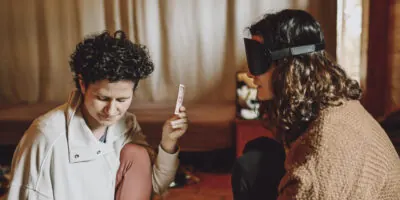
A facilitator showing a card to a blindfolded participant
A session from the Visual Research Commission’s program.

Below is the first episode of Más allá de la Visión (“Beyond Vision”), the series where you can hear them in their own words (in Spanish).

Imagine closing your eyes… and still perceiving. Not as a metaphor, but as an experience you can train: telling shapes apart, light and dark tones, even sensations from your surroundings.

That’s how Beyond Vision begins: a series in which we accompany people who are blind or have low vision as they explore what we call Intuitive Vision —also known as extraocular vision— alongside the Institute’s team (in Spanish).

What Intuitive Vision is (and why it matters here)

We call Intuitive Vision the ability to perceive information from our surroundings without relying solely on physical sight. In popular writing you’ll also see “extraocular vision” or “seeing without eyes,” usually when it’s practiced with a blindfold or under other conditions that block sight.

Beyond the name, what matters is the experience: can people pick up colors, shapes, spatial orientation or inner certainties that are useful in their daily lives? This episode opens that question with real cases.

From a question to a study

Years ago, one question kept coming back to the Institute’s team: could intuition help people who are blind in their everyday lives?

To explore it, we launched a free program and later created the Visual Research Commission (in Spanish). With more coaches, more sessions and more records, the project grew into the study you can now download in full.
Motivation and challenge

Participants arrived with a mix of curiosity, skepticism and practical hopes: “Can this help me move around more safely? Get to know my surroundings? Feel more confident?” For some, regaining a sense of agency after losing their sight is transformative.

Training the improbable: blindfolds, colors, shapes

The exercises include wearing an opaque blindfold, telling figures apart (circle or cross), identifying colors, sensing the space after a guided meditation, and activities with unfamiliar images or videos.

The focus is on recording hits, the sensations that came beforehand and the method used: energetic touch, inner light, inner voice, body, hands…

Testimonials that break the mold

The heart of the episode lies in the voices of the people training.

“I see outlines with the blindfold on”

One participant describes how, wearing a blindfold —even two blindfolds— she can make out the outline of doors, walls and furniture through light and dark contrast. Another practices on her balcony and, after a few deep breaths, begins to “see” the palm trees and the coastline. They jokingly call it “caver’s vision.”

I put on the blindfold and I see the outline of things… I know where the wall is.

I step out onto the balcony and I can make out the bay with the blindfold on.

Program participants

Colors, shapes and bodily sensations

Several exercises with cards showing circles and crosses gave surprising results. In remote sessions, a participant who has been blind since birth began identifying colors by associating them with fruits or foods. Others report perceiving a neon-like light —yellows, blues— around objects they “see” inwardly.

I could feel through my skin that she was drawing a circle.

I had never seen colors… but by linking them to foods, I got them right.

With the blindfold on, I see silhouettes as if lit from within.

Program participants

Confidence, self-esteem and daily life

Beyond the exercises, many describe practical changes: moving around the house with more confidence, walking without turning on the lights, sensing where their guide dog is, making more intuitive decisions at work, or simply feeling more present.

I feel safer at home with the blindfold on than I used to with the lights on.

It’s like coming back to life… my self-esteem goes up.

I feel more intuitive; I even give my boss advice.

Program participants

Beyond chance?

The study measured whether the hits in the tasks —colors, shapes, guided selection— could be explained by random probability. The aggregate results fall outside what chance would predict, and the full analysis, with its methodology and stated limitations, is in the study PDF (in Spanish).

Across its eight episodes, the series follows the same path: the study design, hit rates compared with probability, reported changes in well-being and self-confidence, and the limitations —biases, sample size and the conditions used to block sight.

A note on transparency

We published in open access rather than in a peer-reviewed journal, so this is not the same as formal scientific validation. It is exploratory research, carried out with a protocol and published in full so anyone can examine it, critique it or replicate it. Our other studies are with the Scientific Research Commission (in Spanish).

How to experiment at home

The mindful blindfold game.

Goal: to spark curiosity without jumping to conclusions.
You’ll need: an opaque blindfold, plus 5 cards with a circle and 5 with a cross (or any two clearly contrasting shapes).

  1. Breathe for 1–2 minutes with your eyes closed. Let your mind relax.
  2. Put on the blindfold and make sure it blocks out the light.
  3. Hold your hand over each card without touching it (or touching only the edge).
  4. Allow a sensation, an image, a color or an inner word to come to you.
  5. Sort the cards into two piles: circle and cross.
  6. Write down your intuitions. Repeat after a deeper meditation.
  7. Notice how the information came to you: skin, body, mental image, emotion.

Variations: use strong colors; cold and warm objects; boxes with something inside (a coin) or empty, to work on yes/no intuition.

How to take part

This project began as a question and is now a real program, with dedicated coaches and sessions. If you recognize yourself in anything you’ve just read —or know someone who might— here’s how to join.

Program

10 free one-to-one sessions

Ten individual sessions, at no cost, with an Intuitive Vision coach from the Institute: the same process lived by the people whose words you’ve just read.

For people who are blind or have low vision (30 % vision or less). In person or online, depending on location and availability.

Get in touch to learn more

New this year

Monthly sessions to keep practicing

Free monthly online gatherings for those who have completed the ten sessions and want to keep training as a group.

If you’ve already completed the program, write to us and we’ll let you know about the next one.

Sign me up

Visual Research Commission website (in Spanish)

Keep exploring

Keep exploring

  • 03

    How is it possible?

    Intuitive Vision isn’t magic or a special gift. It’s a capacity all of us have. Understanding how it’s possible is where the inquiry begins.

    Explore more— How is it possible?
  • 06

    Research

    Our inquiry has led us to ask many questions about such a little-known capacity. Research is an essential part of this path.

    Explore more— Research

See all six doors

Intuitive Vision Coach Training

Next English edition

  • 23–31JAN 2027

    Online, in English

    Live on Zoom · 7:00 am – 5:00 pm Eastern Time

    See the training