
Experience it in a one-to-one session
Sometimes no written explanation is enough: you need to live it, ask what you really want to know, and have someone experienced accompany you, looking at your own situation.
Ask about a one-to-one session03 · Explore
What if this weren't magic, but a capacity you already have and simply haven't trained yet?
First, one thing worth saying: we're not going to ask you to believe anything. You don't need faith here, you need curiosity. And if you're the kind of person who wants an explanation before trying something, that's exactly where we'd like to begin.
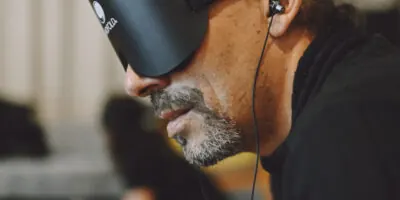
It has probably happened to you: you think of someone for no apparent reason and, minutes later, they call. We usually call that a "hunch" and let it go without a second thought. Researchers such as those at the HeartMath Institute have spent years documenting how the heart picks up information from its surroundings before the brain becomes aware of it.
Intuitive Vision starts from that same idea: it isn't a supernatural sixth sense, it's the fine-tuning of a channel of perception that is already active in you, but that you rarely pay attention to, because the eyes take over almost the entire job of "seeing."
In "What is Intuitive Vision?" we describe the experiment that made this institute famous: the heart changed its rhythm a few seconds before an image appeared, an image the computer hadn't even chosen yet. Here we're interested in the follow-up, because it's the one that says something about the how.
In 2004, McCraty, Atkinson and Bradley published a second part of the study with 26 people and 2,340 trials, measuring heart rhythm and the brain's electrical activity at the same time while two kinds of images appeared on a screen (some neutral, others emotionally intense), chosen at random by the computer at that very moment.
And it's worth saying so plainly, because both readings exist and both have serious people behind them.
You can read it conservatively: an anticipation learned without noticing, an artifact of the experimental setup, a statistical analysis finding structure where there is only noise. These are reasonable objections, and the field itself has been debating them for twenty years.
Or you can read it more broadly: that information about something that hasn't happened yet is already available to the organism, that the body registers it before consciousness does, and that the brain isn't the front door but a way station.
We won't choose for you. But if that second reading were true, even partly, it would change the order of things: perceiving would no longer be something the eyes do and would become something the whole person does, with the eyes as one channel among several.
Which is exactly what people describe when they put on the blindfold.
This is where the explanation we most want to share with you comes in: that of the Mexican researcher Jacobo Grinberg. Grinberg documented dozens of cases, mostly children, who came to perceive colors, shapes or letters through other parts of the body, such as the palms or the forehead, with their eyes completely blindfolded.
His conclusion, after controlled experiments, was clear: this is neither a miracle nor a trick, but a latent capacity that can be developed by changing the way we direct our attention and by learning to create mental silence.
There's a second clue that helps explain why it works better with the eyes covered and, above all, why according to some methods it may come more easily to children: the pineal gland, a tiny structure in the center of the brain that Eastern traditions call "the third eye."
Psychiatrist Rick Strassman has spent decades researching it, and other scientists have found tiny calcite crystals inside it with piezoelectric properties, able to generate a small electromagnetic field under pressure, almost like a miniature antenna.
The detail that struck us most in our research: this gland begins to calcify progressively from around age 12, which is exactly the age at which, according to many methods, this capacity becomes harder to open up.
This is a hypothesis in progress, not a settled answer. Many other theories are being considered in current research on this capacity.
All of this is documented in more depth in the book "Seeing without eyes is possible. Intuitive Vision and Expanded Intuition", in which Tània Agorreta and Jordi Imbert gather two years of their own research with more than 200 participants, including blind people, drawing on concrete measurements: electroencephalograms, heart coherence and electrophotonic imaging.
The book also explores, as a still-open hypothesis rather than a final answer, what quantum physics might bring to this explanation.
And if you'd like to see the studies we've published ourselves, they're all on our research page.
José Alejandro, in the Institute's commentsComing from a technical background, I've always needed a scientific or rational explanation. I have indeed had results, with no possible way of explaining them.
Many times I've been on the edge of madness, unable to find explainable answers for the obvious results appearing right in front of me.
The hypotheses above are the best we have today, and none of them fully closes the question. The shortest way out of doubt isn't a better explanation: it's an afternoon with a blindfold on. Our free introductory course exists for exactly that, and it's coming soon in English.
Sometimes no written explanation is enough: you need to live it, ask what you really want to know, and have someone experienced accompany you, looking at your own situation.
Ask about a one-to-one sessionIf you'd rather keep exploring on your own, this course takes you step by step through the very question you're probably asking yourself: how far can human potential go? Coming soon in English.
Join the waiting listAnd if what's stirred in you isn't just curiosity, but a wish to understand and experience this in depth, and perhaps to accompany others yourself, the Intuitive Vision Coach Training is the next step.
Keep exploring
We explore through lived experience, without closing ourselves off in dogmas or beliefs. Play is how we learn and experiment: every experience has a gift to reveal.
Explore more— The Institute's approachWhen perception expands, what once seemed impossible becomes a new door. Exploration has no limit.
Explore more— What else is possible?Intuitive Vision Coach Training
23–31JAN 2027